
How to Stop Overthinking: Simple and Effective Ways to Find Peace of Mind

Introduction
"What will happen now?", "I shouldn't have done that.", "What should I say?", "I shouldn't have said that."
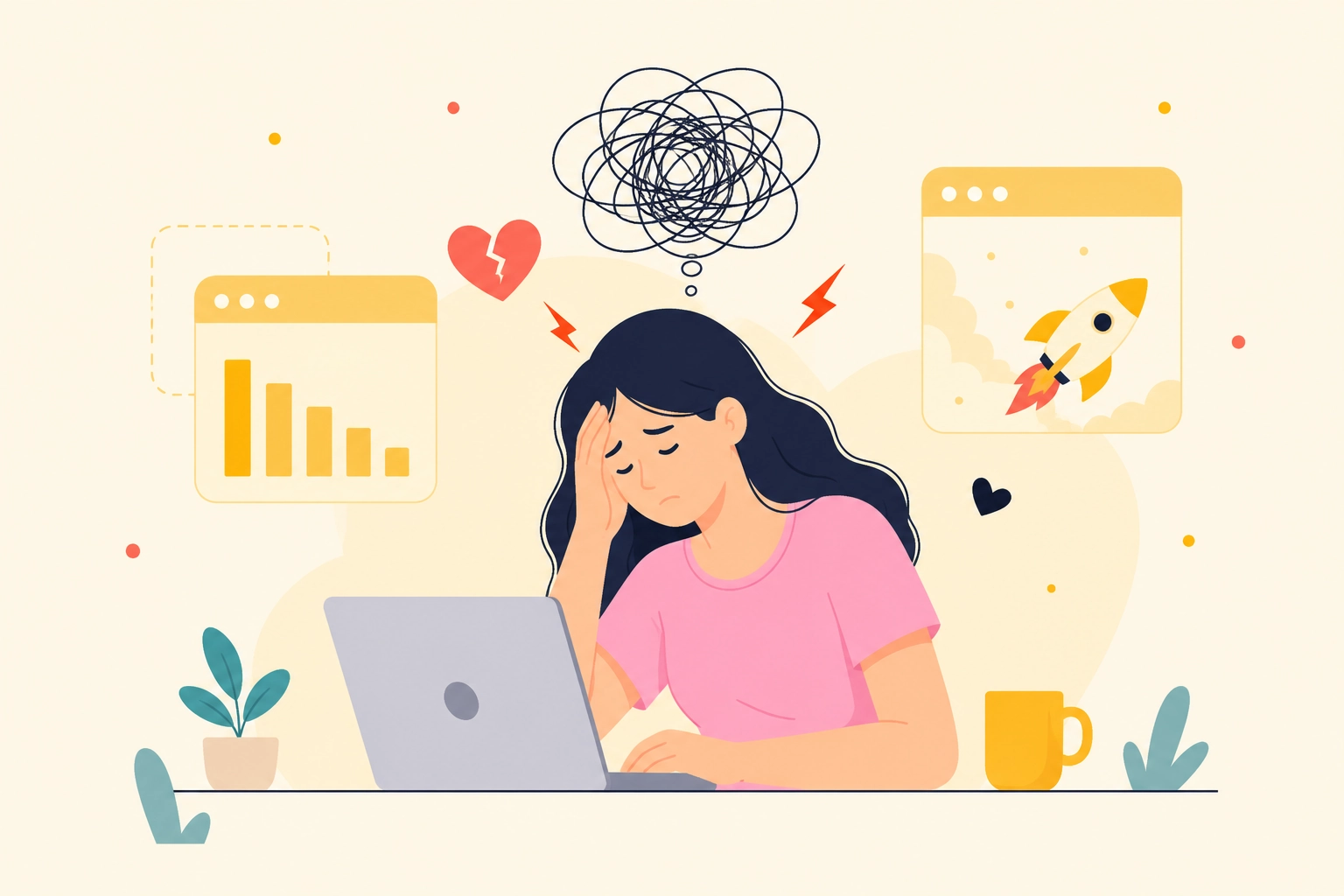
If you feel like these questions are a loop that never quite closes, you already know what overthinking sounds like from the inside - from your brain and even from what you'd call a feeling from the pit of your stomach.
You sometimes go through the same thoughts continuously, without ever landing on a solution. It then leaves you stuck, drained, and emotionally worn out. And it rarely stays contained to just one moment in your head - it loops, time over time. As it latches onto you like a tick, something you can't get rid of, it starts to shape your self-esteem and the way you interact with other people, often leading to over-explaining yourself, assuming the worst, or constantly seeking reassurance from others.
TL;DR
- Overthinking usually comes from a need for certainty and control, not a lack of intelligence.
- It shows up as repetition without resolution, past-focused loops, and mental exhaustion.
- If left unchecked, it can quietly erode self-esteem and relationships.
- You can learn to recognize it in the moment it's happening.
- Small, practical tools work better than trying to "just stop thinking about it."
- The goal isn't to silence your mind - it's to work with the pattern instead of against it.
What Overthinking Really Is
At its very core, overthinking is your brain trying to solve a problem which doesn't even exist - as the name suggests, your brain just "overthinks."
When the future feels uncertain, your mind starts to work overtime, generating every possible outcome rather than accepting that some things simply can't be known in advance. That discomfort of "not knowing," of being clueless and helpless, is often the real engine behind the spiral.
There's also something quieter happening underneath it - something you can't detect with the bare eye. Overthinking creates an illusion of control, a false sense that you have the situation in your hands, in a tight grasp. It feels like you're doing something, even when the outcome was never going to change no matter how many times you replayed it. Sitting with a thought can feel more productive than it actually is.
And sometimes, overthinking shows up as a kind of protection. When something emotionally significant happens, your brain keeps circling back to questions like, "What if I said something wrong? How do I stop this from happening again?" - as if replaying it enough times in your head will prevent the pain from happening a second time. It comes from a good place. But without any real action attached to it, that protective instinct - that false sense of control - slowly turns into overthinking.
What It Looks Like in Real Life
Overthinking doesn't always announce itself. It often hides inside habits that feel normal, even responsible, at times.
It can look like repetition without resolution - returning to the same question and the same conclusion over and over again, without any new insight showing up the tenth time you ask it.
It can look like a past-focused loop. You keep replaying what happened, but rarely land on what could've been done differently. This leaves your mind stuck in self-criticism, with no real action to show for all that mental effort.
It often leaves an emotional aftermath - it makes you feel tired, like your brain has worked a full shift, even though no decision actually got made and no plans were carried out.
And it often brings guilt along with it. Overthinking fills in the missing blanks of situations or life decisions with a series of "what ifs," and without any real evidence, those possibilities can start to feel like facts — leaving you guilty over things that may have never happened at all.
Why This Happens
None of this makes you weak or irrational. Overthinking is usually a response to discomfort, not a character flaw.
Uncertainty is uncomfortable for most people, and the brain's instinct is to try to resolve that discomfort by generating answers, even when no answer actually exists yet. On top of that, overthinking can offer a false sense of comfort, control, and strength in situations where you genuinely don't have much control - which makes it hard to let go of, even when you know it isn't helping.
And when something emotionally important is at stake, your mind treats the situation like a problem still worth protecting you from, even long after the moment has passed.
Why This Is Not Sustainable
Carrying this pattern for too long comes at a cost.
The constant mental replaying is exhausting in a way that doesn't always show on the outside. You might look calm, but internally you're running through scenarios, second-guessing yourself, and rarely arriving at peace.
Left unaddressed, this can start to affect how you show up in relationships too - leading to over-explaining, assuming the worst about others' intentions, or needing frequent reassurance just to feel steady. Over time, that's not sustainable for you or for the people around you.
How to Restore Balance
Restoring balance doesn't mean forcing your mind to go quiet. It means giving it something more useful to do.
- Label what's happening. Simply recognizing "this is overthinking, not problem-solving" creates a small but important distance between you and the loop.
- Shift the question. Instead of asking "why is this happening?" - a question that often has no clean answer - try asking "what do I need right now?" This moves you toward one small, actionable step instead of an endless search for certainty.
- Set a time frame. Give yourself a few intentional minutes to think something through, rather than revisiting it indefinitely. Over time, this reduces the pull to keep coming back to it.
- Change your state. Overthinking tends to pull you into the past or the future. Grounding yourself through movement or sensory tools can help interrupt the cycle and bring you back to the present moment.
What You Need to Remember
You are not broken just because you overthink, and you are not failing at life because your mind loops sometimes.
You are not weak for needing a moment to ground yourself, and you are not overreacting for wanting peace instead of another round of "what ifs."
The goal was never to have a perfectly quiet mind. It's to notice the pattern early enough that it doesn't run the whole show.
Conclusion
Work with the pattern, not against it.
Approaches like Cognitive Behavioral Therapy (CBT) can help you understand exactly how your mind gets stuck in these loops, and help you build newer, steadier ways of responding when it happens again. You deserve:
- To feel that sense of clarity without needing certainty.
- To take one small step instead of a hundred imagined ones.
- To trust yourself without endless review of your actions.
- To exist in the present moment, not just replay the past ones.
Because the truth is: peace of mind doesn't come from having every answer - it comes from knowing you don't need one to move forward.
Get the Latest Expert Insights